Guruvayur Trivandrum Intercity Express Route Map
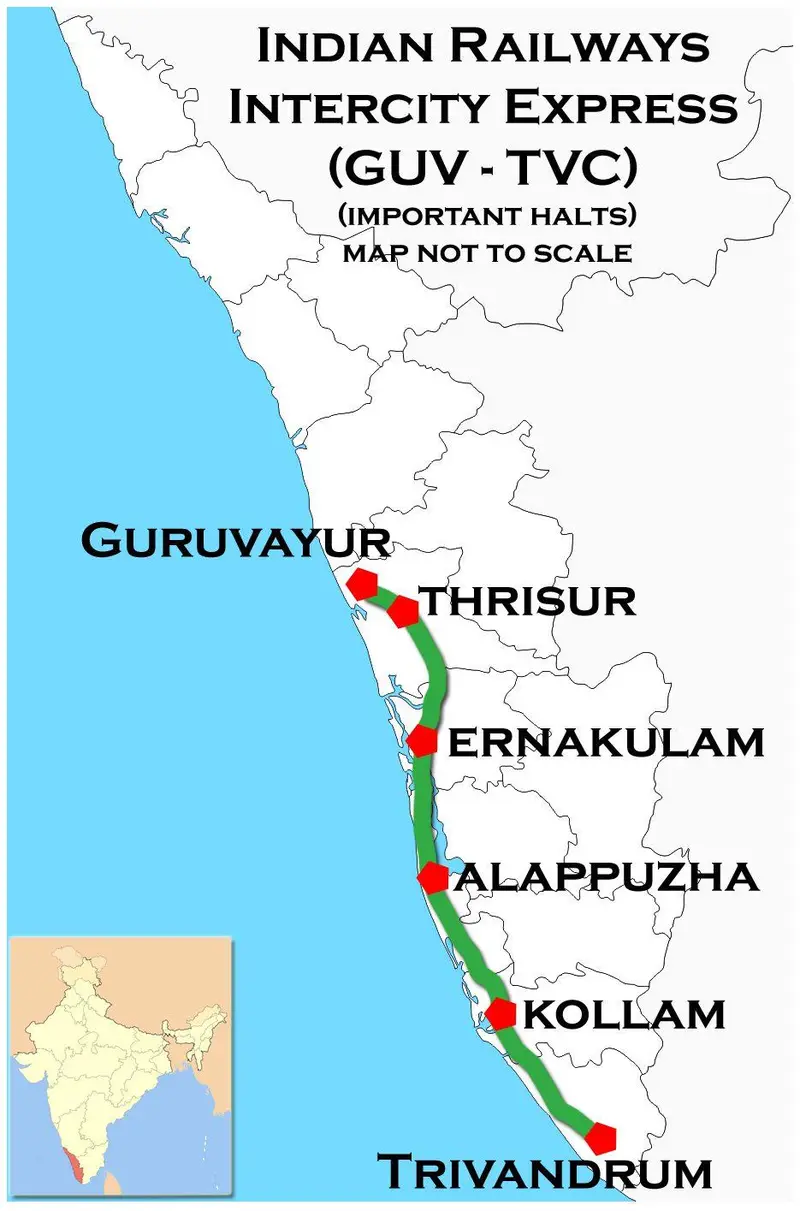
Click or tap the map to enlarge it.
Guruvayur Trivandrum Intercity Express Route Map
Key Takeaways
- The Guruvayur Trivandrum Intercity Express provides a convenient and efficient means of traveling between
Guruvayur and Trivandrum in Kerala, India. - The route map showcases the railway stations and major landmarks along the journey.
- Passengers can enjoy scenic views of Kerala’s beautiful landscapes during the train ride.
- The train offers comfortable seating, onboard amenities, and a reliable schedule.
History
The Guruvayur Trivandrum Intercity Express has a rich history that dates back to its inception in the early
20th century. It was originally introduced to cater to the growing demand for transportation between
Guruvayur, a famous temple town, and the capital city of Trivandrum.
Over the years, the route and infrastructure have been improved to enhance passenger experience and ensure a
smooth journey. Today, the Guruvayur Trivandrum Intercity Express holds a significant place in the region’s
transportation network.
Unique Insights
Here are some unique insights about the Guruvayur Trivandrum Intercity Express route:
- The train route covers a distance of approximately 120 kilometers.
- It passes through picturesque landscapes, including lush green fields, coconut groves, and small towns.
- Traveling by the Intercity Express offers passengers a glimpse into the cultural heritage of Kerala.
- The train provides a comfortable and reliable mode of transportation for both tourists and locals.
- Several famous attractions are located along the route, including the Padmanabhaswamy Temple in
Trivandrum.
Guruvayur Trivandrum Intercity Express Route Map
Table: Relevant Facts
| Date | Event |
|---|---|
| 1928 | Introduction of the Guruvayur Trivandrum Intercity Express |
| 1952 | Route expansion to accommodate increasing passenger demand |
| 1985 | Introduction of modernized train coaches |
| 2005 | Electrification of the entire route for improved efficiency |
FAQ
-
How long does the journey take?
The journey takes approximately 2 hours and 30 minutes.
-
Are reservations required for the Intercity Express?
Reservations are recommended, especially during peak travel seasons.
-
Are there any stops along the route?
Yes, the train stops at various stations, including Thrissur, Ernakulam, and Kollam, among others.
-
Is food available onboard?
Yes, the train provides a pantry car offering a variety of snacks and meals.
-
Can I carry luggage on the train?
Passengers are allowed to carry luggage within specified weight and size limits.
-
Are there any special facilities for differently-abled passengers?
Yes, the train includes provisions for wheelchair accessibility and assistance for differently-abled
passengers. -
Can I purchase tickets online?
Yes, tickets can be booked online through the official Indian Railways website or other authorized
platforms.
External Links
- Guruvayur-Tirunavaya Line – Wikipedia
- Padmanabhaswamy Temple – Kerala Tourism
- Indian Railways Official Website
LSI Keywords:
- Guruvayur Trivandrum Intercity Express
- Guruvayur Trivandrum train route
- Kerala train journey
- Railway stations in Kerala
- Trivandrum attractions
- Indian Railways online booking
- Intercity travel in Kerala
- Kerala temple town